
Egg Donation
Our main guide page explaining the scope of the treatment, our donor pool and the Clavis approach.
ExploreWhere does the journey begin, which step happens where, and when do you travel to Cyprus? On this page we walk you through the egg donation process step by step — from your first message to the pregnancy test — together with a full timeline.
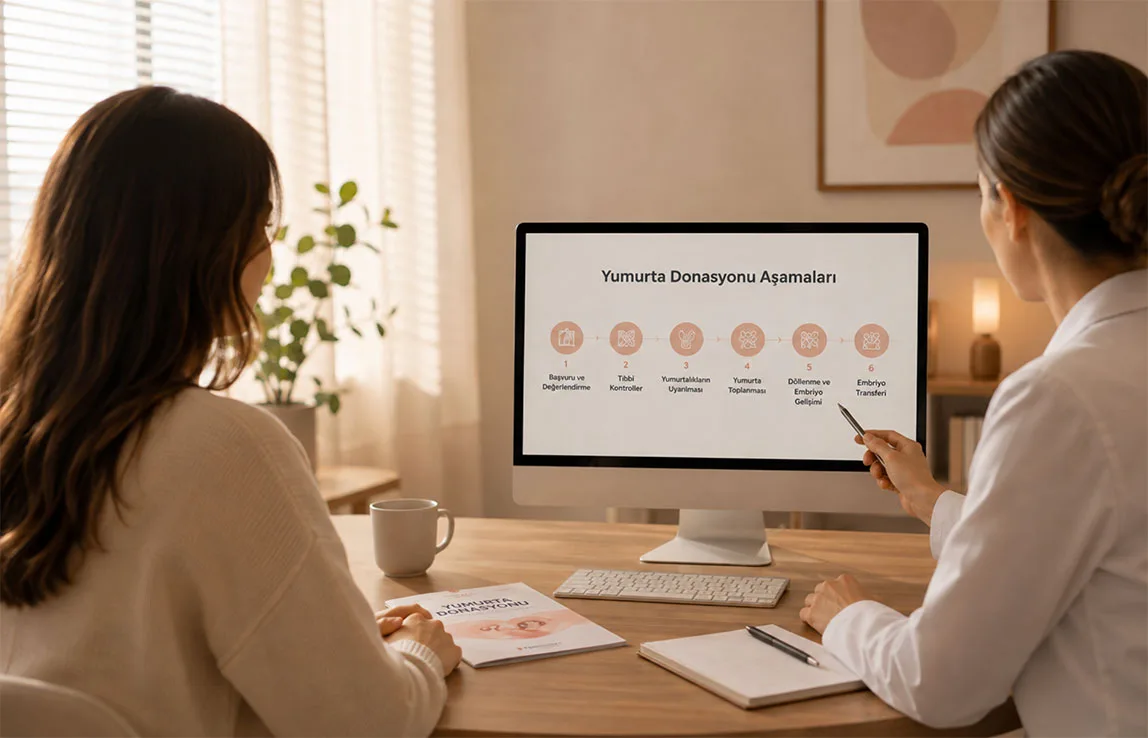
Most of the first five steps take place while you are still in your own country; in egg donation treatment, the time you need to spend in Cyprus is only 5-7 days.
A free consultation is held over WhatsApp; you have your AMH, hormone and sperm tests done in your own city and send the results to our team.
The most suitable donor is identified from our donor pool according to your blood group and physical characteristics; the match is confirmed with your approval.
While the donor's ovaries are stimulated with medication, you simultaneously follow the protocol that thickens your uterine lining in your own country.
The mature eggs collected from the donor are fertilised one by one with the father's sperm using ICSI on the same day. This is the stage at which you travel to Cyprus.
The embryos are cultured in MINC+ incubators for 5-6 days; their development is followed with embryoscopy and the strongest embryo to reach the blastocyst stage is selected.
The selected embryo is placed into your uterus with a thin catheter under ultrasound guidance; embryo transfer is a painless procedure that takes just a few minutes.
Beta hCG is measured in the blood 10-12 days after the transfer; you have the test done in your own city and plan the result and the next steps together with our team.
The time from your first message to the transfer is usually 4-6 weeks. The first two weeks are spent gathering test results and matching a donor; then the donor stimulation and your uterine preparation run simultaneously for about two weeks. The two calendars aligning on the same day is no coincidence: the donor's egg collection day and the day your uterine lining is ready for transfer are deliberately synchronised by adjusting medication doses. This whole plan is personalised to your menstrual cycle and is sent to you as a written schedule.
The part in Cyprus is short: you arrive in time for the egg collection and fertilisation day, stay in Nicosia for the 5-6 days while the embryos develop to the blastocyst stage, and can fly home the day after the transfer. A stay of 5-7 days in total is enough for the entire process; your transfers, hotel and clinic appointments are organised by our team. During the waiting days you can rest and, if you wish, explore the island — these are the calmest days of the treatment.
The first step to starting the process is the free IVF pre-assessment form. You can find the cost components of the treatment on the egg donation cost page, and get support with your flight and accommodation plan from our contact team.
Your transfer week looks roughly like this:
During the 10-12 day period between the transfer and the pregnancy test, you can largely continue with your daily life; bed rest is not required. It is enough to take the progesterone support you are given regularly and to avoid heavy physical exertion. It is important not to test early during this period; urine tests can give misleading results at this stage. For every symptom and every question that crosses your mind, your coordinators are with you 24/7 over WhatsApp.
On the test day, the beta hCG value in the blood is measured and the result is shared with our team. If the result is positive, your medication regimen is updated and a road map is drawn up for monitoring your pregnancy. If good-quality embryos that were not transferred have been frozen by vitrification, they can be used in future attempts without needing a new donor match — which makes the process both shorter and easier.
Spare embryos that reach the blastocyst stage are frozen by vitrification, a method offering a 99% survival rate. That way, when you want a second baby in the future or a new attempt is needed, the transfer can be done with uterine preparation alone, without repeating the donor stages.
To finalise your schedule, you can reach us on our WhatsApp line.
Ask a QuestionFrom the first consultation to the transfer, the process is usually completed within 4-6 weeks. Most of this time is spent in your home country; your stay in Cyprus is only 5-7 days.
You come to Cyprus once your uterine preparation is complete and the donor's egg collection day is confirmed. It is usually enough to arrive on the day of fertilisation or the day before; after the transfer, you can return home following a short rest.
Yes. The medication protocol that thickens the uterine lining is sent to you in writing; you take the medication in your own city and share your ultrasound scan results with our team via WhatsApp.
Fertilised embryos are cultured in MINC+ incubators for 5-6 days and monitored continuously with embryoscopy. The embryo that reaches the blastocyst stage in the healthiest condition is selected for transfer; remaining good-quality embryos can be frozen by vitrification.
No. The transfer is a procedure of a few minutes performed with a thin catheter under ultrasound guidance; it requires no anaesthesia and causes no pain. After a short rest, you can return to your hotel.
The pregnancy test is done by measuring beta hCG in the blood 10-12 days after the transfer. You can have the test at any laboratory in your own city; you share the result with our team and the next steps are planned together.
Let us draw up your personal timeline according to your menstrual cycle; let our team organise your flights, accommodation and clinic appointments for you.
Average response time: 15 minutes · 24/7 WhatsApp supportYou've learned the process; now explore the definition, the eligibility criteria and the cost.
Our main guide page explaining the scope of the treatment, our donor pool and the Clavis approach.
ExploreA clear definition of the treatment, its genetic and epigenetic dimension, legal framework and success rates.
ExploreEarly menopause, low reserve, advanced age: a detailed list of the situations in which the treatment is suitable.
ExploreThe scope of the donation packages, the factors affecting the price and a transparent cost guide.
ExploreFor information only; not a substitute for medical diagnosis. Chats are recorded for quality purposes.